
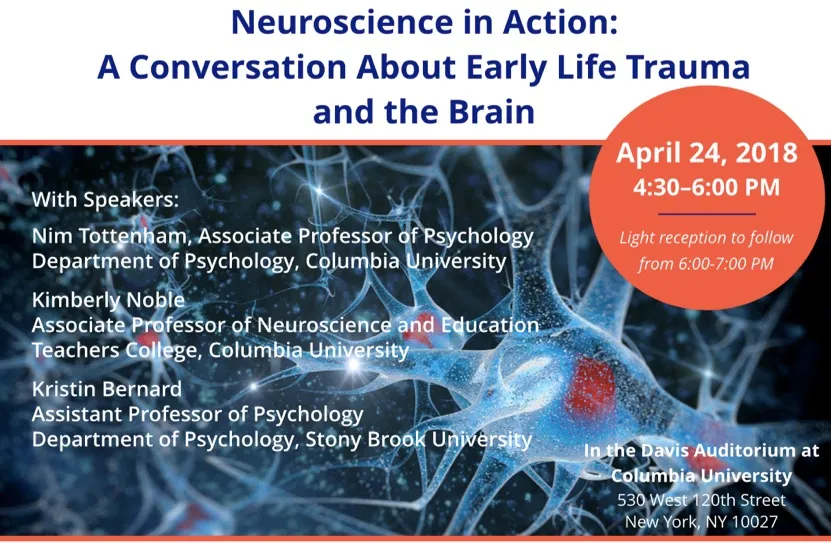
On April 24, 2018, Trauma-Free NYC in collaboration with Science and Society hosted our second Speaker Series event.
Neuroscience in Action: A Conversation about Early Life Trauma and the Brain explored how exposure to psychosocial adversity relates to children's behavioral and neurobiological development. Dr. Nim Tottenham, Dr. Kimberly Noble, and Dr. Kristin Bernard presented recent findings on emotional and cognitive development and their associated biological correlates. They also discussed the pathways that increase risk, resilience across development, and potential intervention strategies.
The 20 minute presentations were followed by a moderated Q&A with Dr. Jay Gingrich.
Watch the full 1.5 hour video or to each presentation individually below.
Dr. Kimberly Noble presented " Inequality, Children and Brain Development" where she explored in depth the impact of socio-economic status and chronic stress on brain development.
Dr. Noble spoke about her newest research project, a 5-year randomized control trial that will provide families with unconditional cash transfers. The aim of the study is to determine the causal impact of cash transfers on children's cognitive, emotional and brain development.
Dr. Nim Tottenham presented Development of Emotion Regulation Neurobiology: The Importance of Early Experiences. She describes the work that her lab, the Developmental Affective Neuroscience Laboratory at Columbia University, conducts to learn about the impact of early adversity on the brain.
Dr. Tottenham goes into detail about the biological correlates of abuse and neglect. She explains the neurobiological impacts of childhood trauma in great detail.
Dr. Kristin Bernard presented "Early Life Stress, Parenting, and Neurobiology: A Translational Approach to Intervention". Dr. Bernard is an Associate Professor at Stony Brook University. In her talk, she describes in detail how to measure stress through cortisol sampling.
Dr. Bernard also presents findings from her work on the Attachment and Biobehavioral Catch-up, also known as ABC intervention. This is a promising way forward for promoting attachment, responsive parenting, and child development.
Dr. Jay Gingrich invited the panel for a moderated Q & A with the audience.
Watch the entire 1.5 hour event above!